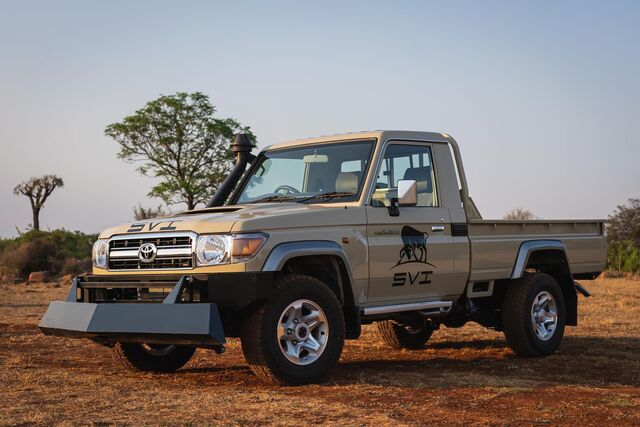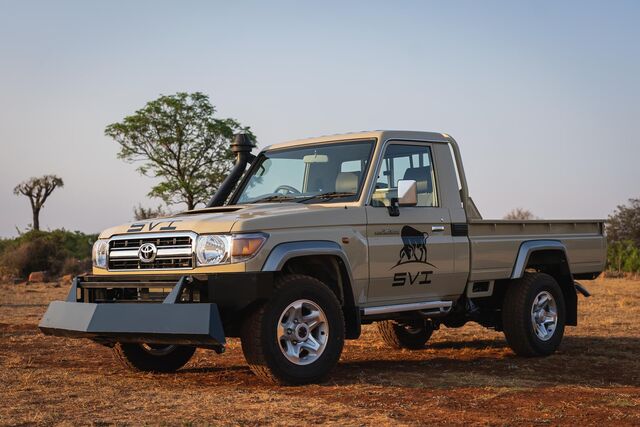
Designed from scratch, the SVI anti-riot scraper more than meets the requirements by enabling standard vehicles, like the Toyota Land Cruiser 79, to safely clear a path through the debris to allow security and medical personnel access to critical locations.
The SVI anti-riot scraper and hydraulic power pack come as a unit for easy installation in a couple of hours. The weight of around 100 kg is comparable to a standard bulbar and winch fitted to many off-road vehicles.
Functioning as a normal bumper in the raised position, it can be hydraulically lowered (and raised) by pressing a button inside the cabin. Different angles of attack are available, depending on the obstacle that needs to be moved.
A fire-extinguishing option is available that can be fitted to the blade to extinguish burning objects as the vehicle approaches them.
The first unit is now available for the Toyota Land Cruiser 79 (and its MAX 3 derivative), but SVI can adapt the system for many other vehicles upon request. SVI is currently developing a version for the Toyota Hilux and Ford Ranger bakkies.
The SVI scraper takes 4 weeks to manufacture from order, and installation is completed in less than a day. The retail cost for the SVI anti-riot scraper for the Land Cruiser 79 is R64 995, excluding VAT.