EU – especially Germany – SA’s main trading partner
South Africa and its automotive industry are set to build resilience in 2025 and strengthen their trading position amid rising geopolitical uncertainties.
Share with friends
The domestic automotive industry’s top automotive regional trading partner in 2024 remained the European Union (EU), according to data in the latest edition of the Automotive Business Council’s (naamsa) Automotive Trade Manual 2025.
Vehicle and automotive component exports to the EU increased by R9.6 billion, or 6.5%, from R147.1 billion in 2023 to R156.7 billion in 2024, mainly owing to a rise in the value of vehicle exports to the region.
Automotive imports from the EU decreased by R900 million, or 0.7%, from R139.4 billion in 2023 to R138.5 billion in 2024, in line with lower original equipment component imports from the region.
The EU, Africa and US-Mexico-Canada Agreement (USMCA) were the regions with a trade surplus in 2024. The largest deficit was recorded with the 48-country Asia region, including countries such as China, Japan, India and Thailand.
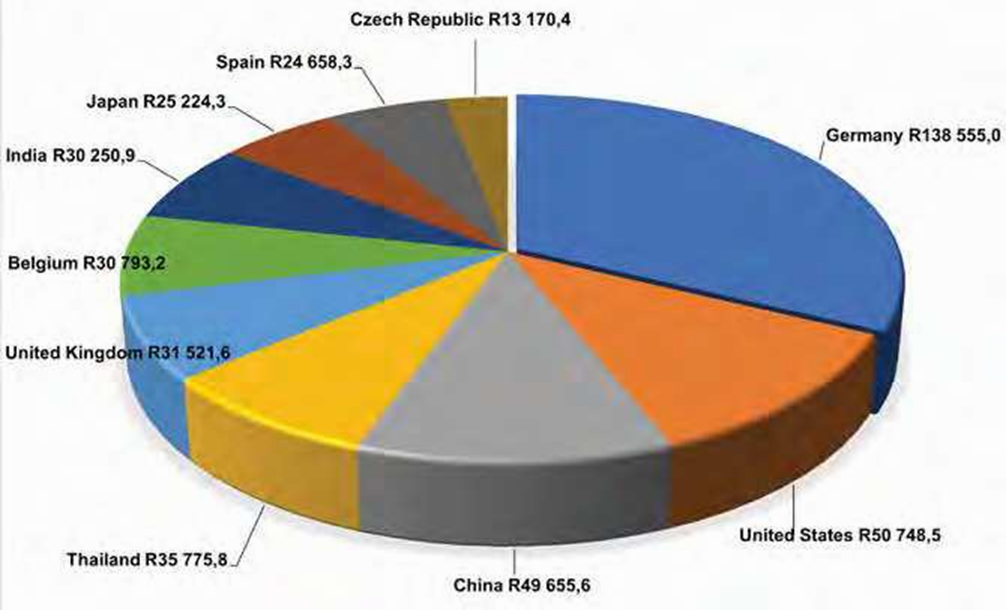
Germany, home to BMW, Volkswagen and Mercedes-Benz, remained the South African automotive industry’s biggest single trading country partner (exports and imports of vehicles and components combined) in 2024. Despite decreasing from the R161.1 billion in 2023, total automotive trade between the two countries still reached a significant R138.6 billion in 2024.
The South African automotive industry’s trade relationship with five of its top trading countries reflected a surplus in 2024. There were no changes in South Africa’s top 10 automotive trading partners, but China improved its ranking year-on-year in 2024.
The global transition to EVs is reshaping South Africa’s automotive export landscape considering the decrease in exports for internal combustion engine (ICE) vehicle components over the past two years. Four OEMs are currently manufacturing hybrids and plug-in hybrid models (Toyota, Ford, Mercedes-Benz and BMW) in the domestic market, while several localisation opportunities for EV components have been identified or already exist and should contribute to offset the losses in ICE vehicle component exports over the medium term.
South Africa’s main automotive regional trade partners – 2024:
Buyers with a budget but no shortlist are getting more help, and dealers have a few changes of their own to look forward to. In this article, sponsored by AutoTrader, we look at how AutoTrader is changing how buyers find cars and how dealers get them advertised.
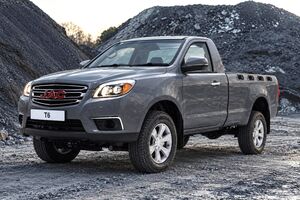
JAC Motors South Africa has launched the T6 2.0L CTi 4x4 single cab bakkie, ten months after the T6 4x2 arrived in January. The T6 4x4 was first sold locally as a double cab in 2017, and it now enters the single cab segment. With this addition, the T-Series offers 4x4 derivatives across the T6, T8 and T9 ranges.
Cheap labour and state subsidies are the usual explanations for Chinese car prices. Research from think tanks and universities suggest the answer is far more complicated.
Cars are the ultimate symbol of freedom, independence and individualism. They offer the freedom to ‘go anywhere,’ whenever it suits and with whom one chooses.
Cheap labour and state subsidies are the usual explanations for Chinese car prices. Research from think tanks and universities suggest the answer is far more complicated.
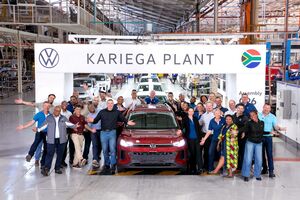
The first Volkswagen Tengo destined for an African customer rolled off the production line at Plant Kariega on 9 November 2026, making history in more ways than one.