10 year driving licence cards approved, but implementation date unclear
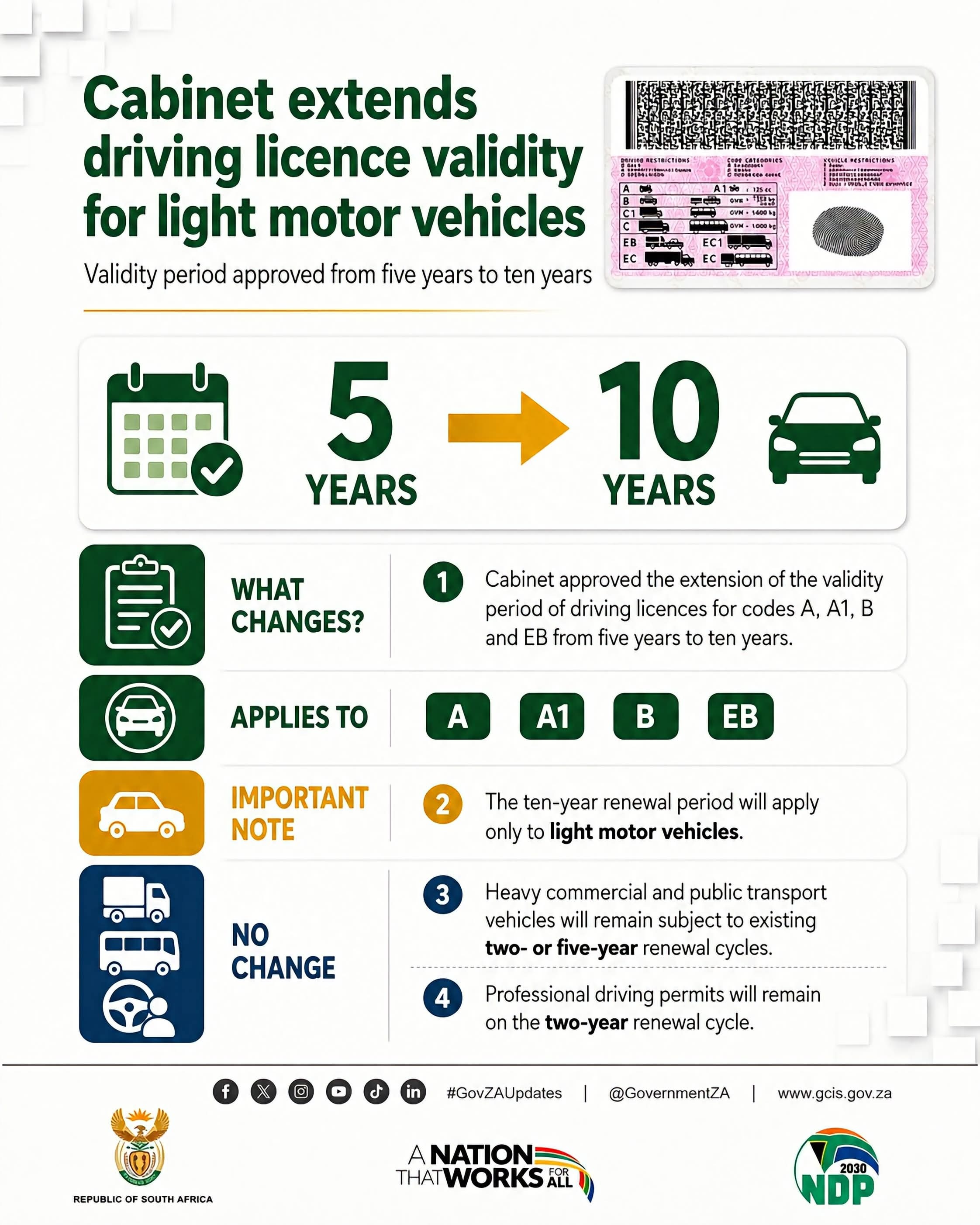
The Cabinet has approved a proposal to extend the validity period of South Africa's driving licence cards for light motor vehicles from five years to ten years, a move aimed at reducing the frequency of renewals and easing pressure on the country's licensing system.
Share with friends
However, the change is not yet in effect, with motorists still needed to renew their licences under the existing five year system until the necessary legal amendments have been finalised and published.
Minister in the Presidency Khumbudzo Ntshavheni announced the decision during a post Cabinet media briefing on 30 July, according to media reports, confirming that the longer validity period will apply to licence codes A, A1, B and EB, which cover motorcycles and light motor vehicles.
The current renewal cycles for heavy commercial and public transport vehicles, which range between two and five years, will remain unchanged. Professional Driving Permits will also continue to be renewed every two years.
According to Cabinet, the decision aligns South Africa more closely with international practice while improving administrative efficiency, reducing the frequency with which motorists need to renew their licence cards and easing demand on the country's licensing system.
The Department of Transport has not yet indicated when the new validity period will come into force. Before implementation can begin, amendments to the relevant legal prescripts must be published. Until then, motorists whose driving licence cards expire must continue renewing them in accordance with the existing legislation.
The Organisation Undoing Tax Abuse (OUTA), which has campaigned for longer licence validity periods since the disruption caused by the Covid 19 pandemic in 2020, welcomed Cabinet's decision. The organisation said it had researched driving licence validity periods in 35 countries and found an average validity period of 8.5 years, with renewal periods ranging from three to 20 years.
OUTA Chief Executive Officer Wayne Duvenage says the change would save motorists both time and money by reducing the number of renewals required over a driver's lifetime. He also said motorists would have fewer visits to driving licence testing centres, helping them avoid queues and administrative delays associated with the renewal process.
Reducing the number of renewals could also benefit motorists travelling long distances to licensing facilities, particularly those living in areas where testing centres are limited. Fewer renewals would mean fewer administrative appointments and less time spent at traffic or licensing offices, while also reducing the demand placed on these facilities.
In its research, OUTA found no evidence that longer validity periods for ordinary driving licence cards were linked to higher road fatality rates. The organisation said road safety is determined by factors such as effective law enforcement, competent drivers, roadworthy vehicles and safe road infrastructure rather than the frequency with which licence cards are renewed.
The organisation also highlighted findings from a 2021 survey of 3 685 motorists, in which 65 percent reported frustration with the online booking system, 60 percent complained about long queues, about 45 percent cited poor staff attitudes and more than 10 percent said they had witnessed bribery during the renewal process.
Although Cabinet has approved the policy, uncertainty remains over its implementation. The Department of Transport has yet to confirm when the amended regulations will take effect or whether the ten year validity period will apply only to licence cards issued after the commencement date or also to cards already in circulation. Until those details are published, motorists must continue complying with the current five year renewal requirements.
A dispute over the payload ratings of Jetour’s T1 and T2 SUVs has developed further following weighbridge testing in Gauteng, with the Automobile Association (AA) questioning some of the results and Jetour South Africa maintaining that its revised figures have been independently verified.
Chinese vehicle manufacturers continued to record significantly stronger growth than established OEM brands in South Africa during the second quarter of 2026, according to TransUnion's Q2 2026 Mobility Report.
A dispute over the payload ratings of Jetour’s T1 and T2 SUVs has developed further following weighbridge testing in Gauteng, with the Automobile Association (AA) questioning some of the results and Jetour South Africa maintaining that its revised figures have been independently verified.
Chinese vehicle manufacturers continued to record significantly stronger growth than established OEM brands in South Africa during the second quarter of 2026, according to TransUnion's Q2 2026 Mobility Report.
South African consumers face growing pressure on household finances after the South African Reserve Bank raises interest rates, adding to a range of rising costs that are already influencing vehicle purchasing decisions.