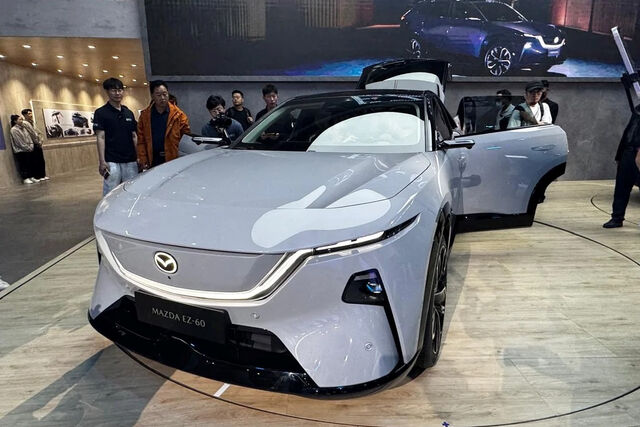
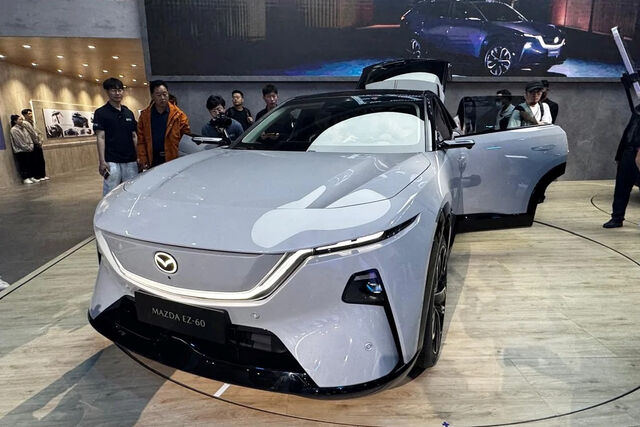
Mazda has unveiled its EZ-60, an electric crossover SUV, the result of a joint venture between Mazda and Changan Automobile. It is the second electric vehicle (NEV) manufactured by Changan Mazda.
Share with friends
It will go on sale in China during this year, and this new model will expand Mazda's electric vehicle line-up in the Chinese market together with EZ-6 launched last year.
The Mazda EZ-60 will be available in electric vehicle (BEV) and the plug-in hybrid vehicle (PHEV) models.
Masahiro Moro, President and CEO of Mazda Motor Corporation, said: "We are very pleased to unveil our second new electric vehicle that brings together the strengths of Mazda and Changan Automobile this year, which marks the 20th anniversary of Changan Mazda, and we feel truly grateful for the support of our customers in China.
A first-class driving experience is predicted with its 50:50 front/rear weight distribution, strut suspension at the front and multi-link suspension at the rear, and electronically controlled dampers that can respond to a variety of driving situations.
The driving range is expected to be around 600km for the BEV model and more than 1 000km per refuelling for the PHEV model.
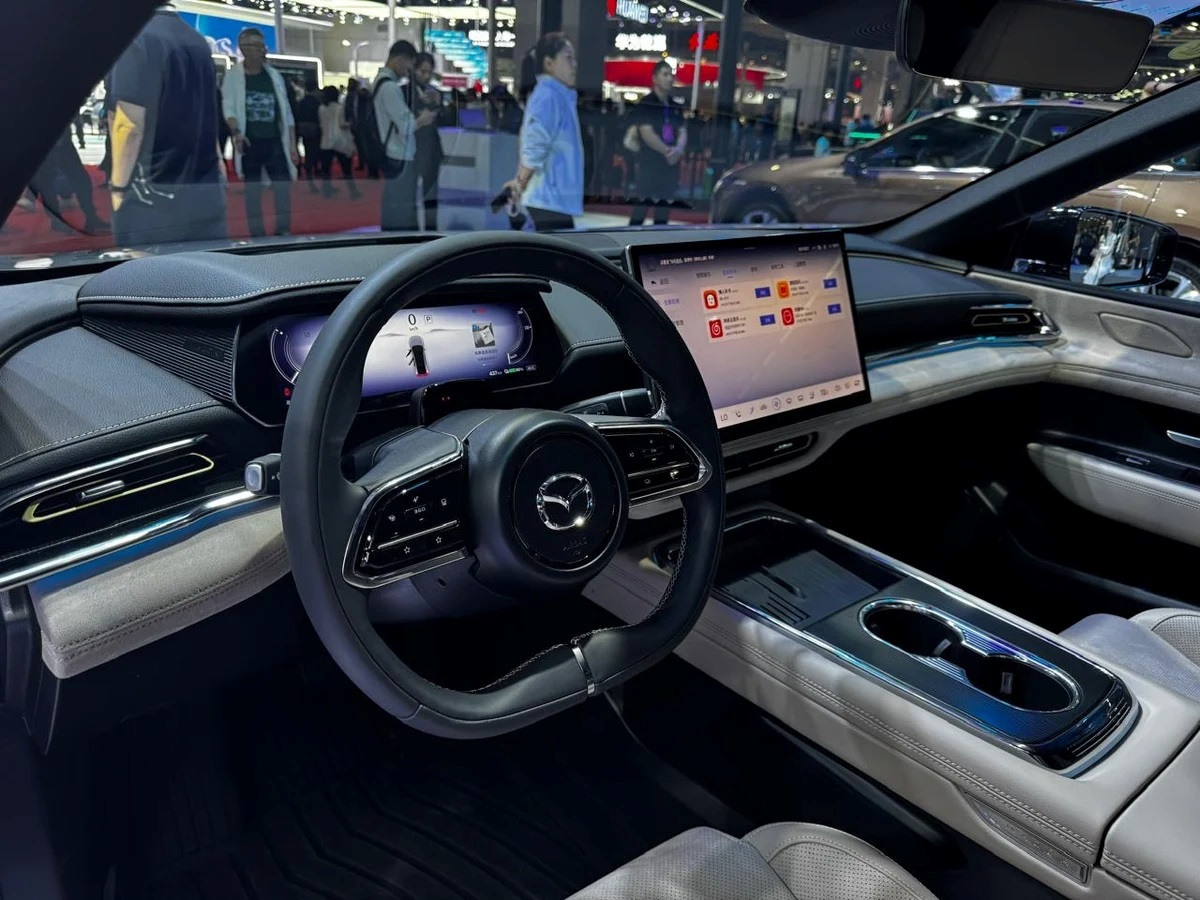
Some smart features include a smart cabin that can be operated by voice, touch or gesture; the intelligent drive to help the driver avoid an accident or reduce damage; and the intelligent parking that can be operated by voice even from outside the vehicle.
Inside is a 26.45-inch 5K integrated flat-panel centre display and a virtual 3D head-up display. Information and visuals displayed prominently in front of the driver support safety and security while providing a futuristic driving experience.
A powerful and realistic sound experience is delivered through 23 speakers and a 3D sound system. In addition, the headrest speakers allow the driver and front passenger to listen to different music.
A dispute over the payload ratings of Jetour’s T1 and T2 SUVs has developed further following weighbridge testing in Gauteng, with the Automobile Association (AA) questioning some of the results and Jetour South Africa maintaining that its revised figures have been independently verified.
Chinese vehicle manufacturers continued to record significantly stronger growth than established OEM brands in South Africa during the second quarter of 2026, according to TransUnion's Q2 2026 Mobility Report.
South Africa's new energy vehicle market is becoming increasingly diverse, with plug in hybrid electric vehicles (PHEVs) and fully electric vehicles gaining ground while traditional hybrids remain the largest category.
As South Africans celebrate their rich heritage, it is also worth reflecting on a lesser-known chapter of the country's history: its long connection with electric vehicles (EVs).